
Gene Transfer Methods : Types, Techniques, and Applications in Modern Biotechnology
Introduction to Gene Transfer Methods
Gene transfer methods are techniques used to introduce foreign genetic material (DNA or RNA) into a host cell. These methods are essential in molecular biology, genetic engineering, and biotechnology, allowing scientists to study gene function, modify organisms, and develop new therapies.
Today, gene transfer methods are widely applied in medicine, agriculture, and research, making them a cornerstone of modern science.
Types of Gene Transfer Methods
Gene transfer methods are divided into two major categories:
1. Natural Gene Transfer Methods
Natural gene transfer occurs without human intervention and is common in microorganisms, especially bacteria.
2. Artificial Gene Transfer Methods
Artificial gene transfer methods are laboratory techniques developed to introduce DNA into cells in a controlled manner.
Natural Gene Transfer Methods
Natural gene transfer methods play a key role in evolution and genetic diversity.
Transformation
Transformation is a process where cells take up free DNA from their environment.
- Common in bacteria
- Used in genetic engineering
- Enables acquisition of new traits
Conjugation
Conjugation involves direct transfer of DNA between two cells through physical contact.
- Requires a structure called a pilus
- Transfers plasmids efficiently
- High gene transfer rate
Transduction
Transduction is the transfer of genetic material via viruses (bacteriophages).
- DNA is carried by viral particles
- Two types:
- Generalized transduction
- Specialized transduction
Important in bacterial evolution and virulence
Artificial Gene Transfer Methods
Artificial gene transfer methods are widely used in laboratories and industrial biotechnology.
Electroporation
Electroporation uses electrical pulses to create temporary pores in the cell membrane.
- DNA enters through membrane openings
- High efficiency
- Applicable to many cell types
Microinjection
Microinjection involves directly injecting DNA into a cell nucleus using a fine needle.
- Extremely precise
- Used in embryos and transgenic organisms
- Common in animal studies
Biolistic Method (Gene Gun)
This method uses high-velocity particles coated with DNA to penetrate cells.
- Common in plant transformation
- Useful for tough cell walls
Viral Vector-Mediated Gene Transfer
Viruses are modified to deliver genetic material into host cells.
- Very high efficiency
- Widely used in gene therapy
- Allows targeted gene delivery
Lipofection (Chemical Method)
Lipofection uses lipid-based vesicles to carry DNA into cells.
- Liposomes fuse with cell membranes
- Safe and widely used in research
- Suitable for in vitro applications
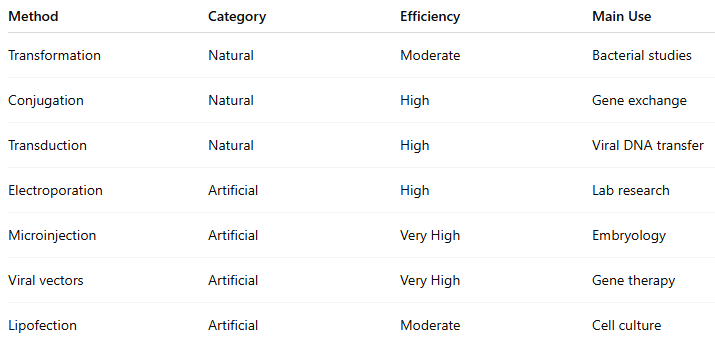
Comparison of Gene Transfer Methods
Applications of Gene Transfer Methods
1. Medical Applications
- Gene therapy for genetic diseases
- Vaccine development
- Cancer treatment
2. Biotechnology
- Production of recombinant proteins
- Development of engineered microorganisms
3. Agriculture
- Genetically modified crops
- Improved resistance to pests and diseases
4. Scientific Research
- Functional genomics
- Gene expression studies
- CRISPR-based technologies
Advantages and Limitations of Gene Transfer Methods
Advantages
- Enables precise genetic modification
- Supports advanced medical treatments
- Accelerates research and innovation
Limitations
- Ethical concerns
- Risk of unintended mutations
- Possible immune responses
Conclusion
Gene transfer methods are fundamental tools in modern science. From natural processes such as transformation and transduction to advanced techniques like electroporation and viral vectors, these methods have revolutionized biology and medicine.
Understanding gene transfer methods is essential for anyone working in biotechnology, genetics, or biomedical research.