
Ziehl-Neelsen Zn stain procedure: Principle, Procedure, Results, and Applications
Introduction to Ziehl-Neelsen Staining
Ziehl-Neelsen Staining is a classical microbiological staining technique used to identify acid-fast bacteria, especially Mycobacterium tuberculosis, the causative agent of tuberculosis.
This method remains a gold standard in clinical microbiology, particularly in low-resource settings, due to its simplicity, reliability, and cost-effectiveness.
Principle of Ziehl-Neelsen Staining
The principle of Ziehl-Neelsen Staining is based on the unique composition of the bacterial cell wall.
- Acid-fast bacteria contain mycolic acids, complex lipids that make their cell walls waxy
- These lipids allow the cells to retain the primary stain even after treatment with strong decolorizing agents
Outcome:
- Acid-fast organisms → Red/Pink
- Non-acid-fast organisms → Blue
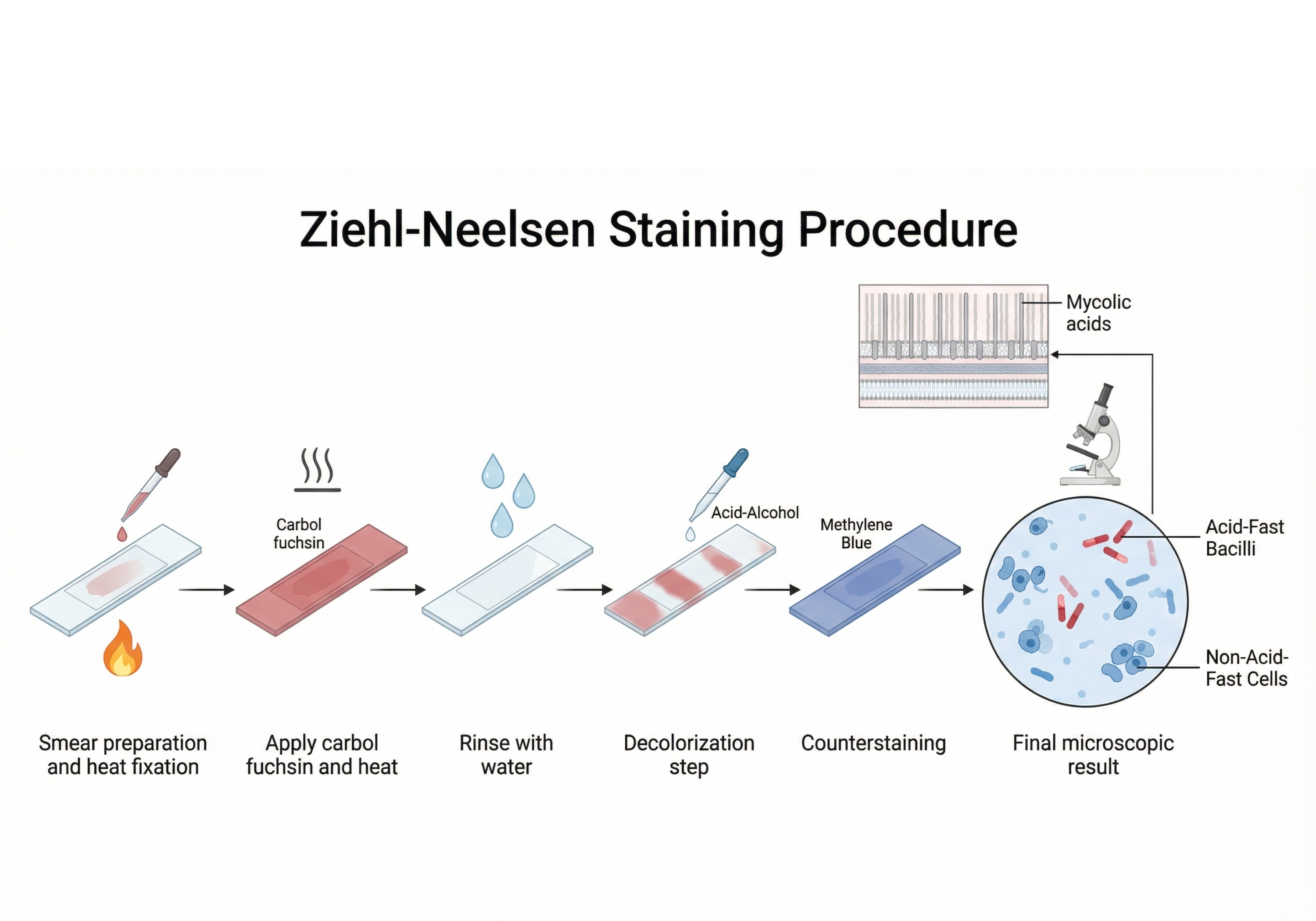
Reagents Used in Ziehl-Neelsen Staining
The Ziehl-Neelsen Staining technique requires three main reagents:
- Carbol Fuchsin – Primary stain
- Acid-Alcohol – Decolorizing agent
- Methylene Blue – Counterstain
Ziehl-Neelsen Staining Procedure
Follow this standard Ziehl-Neelsen Staining protocol:
1. Smear Preparation
- Prepare a thin smear on a clean glass slide
- Air dry and heat fix
2. Primary Staining
- Flood the slide with carbol fuchsin
- Heat gently until steam appears (do not boil)
- Allow staining for 5 minutes
3. Washing
- Rinse with distilled water
4. Decolorization
- Apply acid-alcohol for 1–2 minutes
- Wash again with water
5. Counterstaining
- Add methylene blue for 1–2 minutes
- Rinse and air dry
6. Microscopic Examination
- Observe under oil immersion (100× objective)
Interpretation:
- Acid-fast bacilli → Bright red rods
- Background cells → Blue
Results and Interpretation
| Organism Type | Color After Staining | Interpretation |
|---|---|---|
| Acid-fast bacteria | Red/Pink | Positive result |
| Non-acid-fast bacteria | Blue | Negative result |
Applications of Ziehl-Neelsen Staining
1. Clinical Diagnosis
- Detection of Mycobacterium tuberculosis
- Identification of Mycobacterium leprae
2. Public Health
- Screening for infectious diseases like tuberculosis
- Monitoring treatment effectiveness
3. Research
- Study of acid-fast organisms
- Microbial classification
Advantages of Ziehl-Neelsen Staining
- Simple and inexpensive
- Rapid diagnostic method
- Highly specific for acid-fast bacteria
Limitations of Ziehl-Neelsen Staining
- Lower sensitivity compared to molecular techniques (PCR)
- Requires experienced personnel
- Cannot differentiate between species
Precautions and Safety
- Avoid overheating during staining
- Use proper biosafety procedures
- Handle infectious samples carefully
Conclusion
Ziehl-Neelsen Staining is a fundamental technique in microbiology that continues to play a vital role in diagnosing acid-fast infections. Despite modern molecular advancements, it remains an essential method due to its accessibility and effectiveness.
Understanding Ziehl-Neelsen Staining is crucial for students, researchers, and healthcare professionals involved in infectious disease diagnostics.