
Column Chromatography
Introduction
Column Chromatography is a widely used laboratory technique for the separation and purification of chemical compounds. It is based on the differential adsorption of substances between a stationary phase and a mobile phase.
In modern chemistry and biotechnology, Column Chromatography plays a critical role in isolating biomolecules such as proteins, nucleic acids, and small organic compounds.
Principle of Column Chromatography
The principle of Column Chromatography relies on the interaction between compounds and the stationary phase.
- The stationary phase is usually a solid adsorbent such as silica gel or alumina
- The mobile phase is a liquid solvent that carries the sample through the column
Compounds with strong affinity for the stationary phase move slowly, while those with weak interactions move faster.
This results in separation based on:
- Polarity
- Molecular size
- Chemical properties
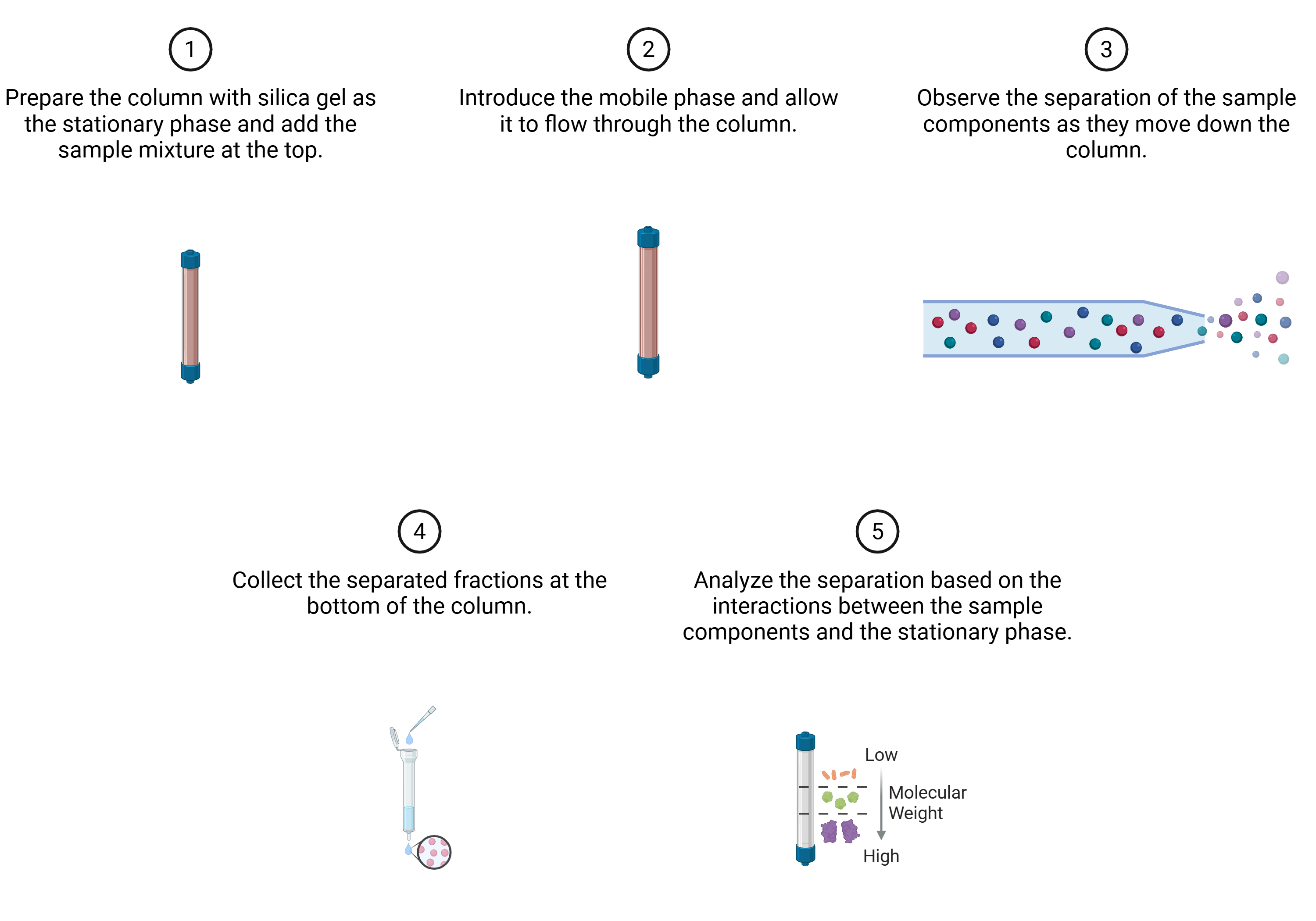
Components of Column Chromatography
A typical Column Chromatography setup includes:
- Glass column
- Stationary phase (silica gel or alumina)
- Mobile phase (solvent or solvent mixture)
- Sample mixture
- Collection tubes
Procedure of Column Chromatography
The procedure of Column Chromatography involves several steps:
1. Column Packing
- The column is filled with the stationary phase
- Ensures uniform distribution
2. Sample Loading
- The sample is carefully placed on top of the column
3. Elution
- The solvent (mobile phase) is passed through the column
- Compounds travel at different speeds
4. Collection of Fractions
- Separated compounds are collected in different tubes
Types of Column Chromatography
There are several important types of Column Chromatography:
1. Adsorption Column Chromatography
- Separation based on adsorption to the surface
- Common stationary phases: silica, alumina
2. Partition Column Chromatography
- Based on partitioning between two liquid phases
3. Ion Exchange Chromatography
- Separates molecules based on charge
- Used for proteins and amino acids
4. Gel Filtration (Size Exclusion Chromatography)
- Separation based on molecular size
- Larger molecules elute first
5. Affinity Chromatography
- Highly specific interaction between molecule and ligand
- Used in protein purification
Applications of Column Chromatography
Column Chromatography is essential in many scientific fields:
1. Pharmaceutical Industry
- Drug purification
- Quality control
2. Biotechnology
- Protein purification
- Enzyme isolation
3. Environmental Analysis
- Detection of pollutants
4. Food Industry
- Analysis of additives and contaminants
Advantages of Column Chromatography
- High separation efficiency
- Simple and cost-effective
- Versatile technique
- Applicable to a wide range of compounds
Limitations of Column Chromatography
- Time-consuming
- Requires large volumes of solvent
- Manual operation may reduce reproducibility
Conclusion
Column Chromatography is a fundamental separation technique in chemistry and life sciences. Its ability to purify complex mixtures makes it indispensable in research, pharmaceuticals, and industrial applications.
Understanding Column Chromatography is essential for students, researchers, and professionals working in analytical and biochemical laboratories.