
Aminopropargyl dGTP [5-Propargylamino-2'-deoxyguanosine-5'-triphosphate]
Aminopropargyl dGTP
5-Propargylamino-2'-deoxyguanosine-5'-triphosphate
Product Overview
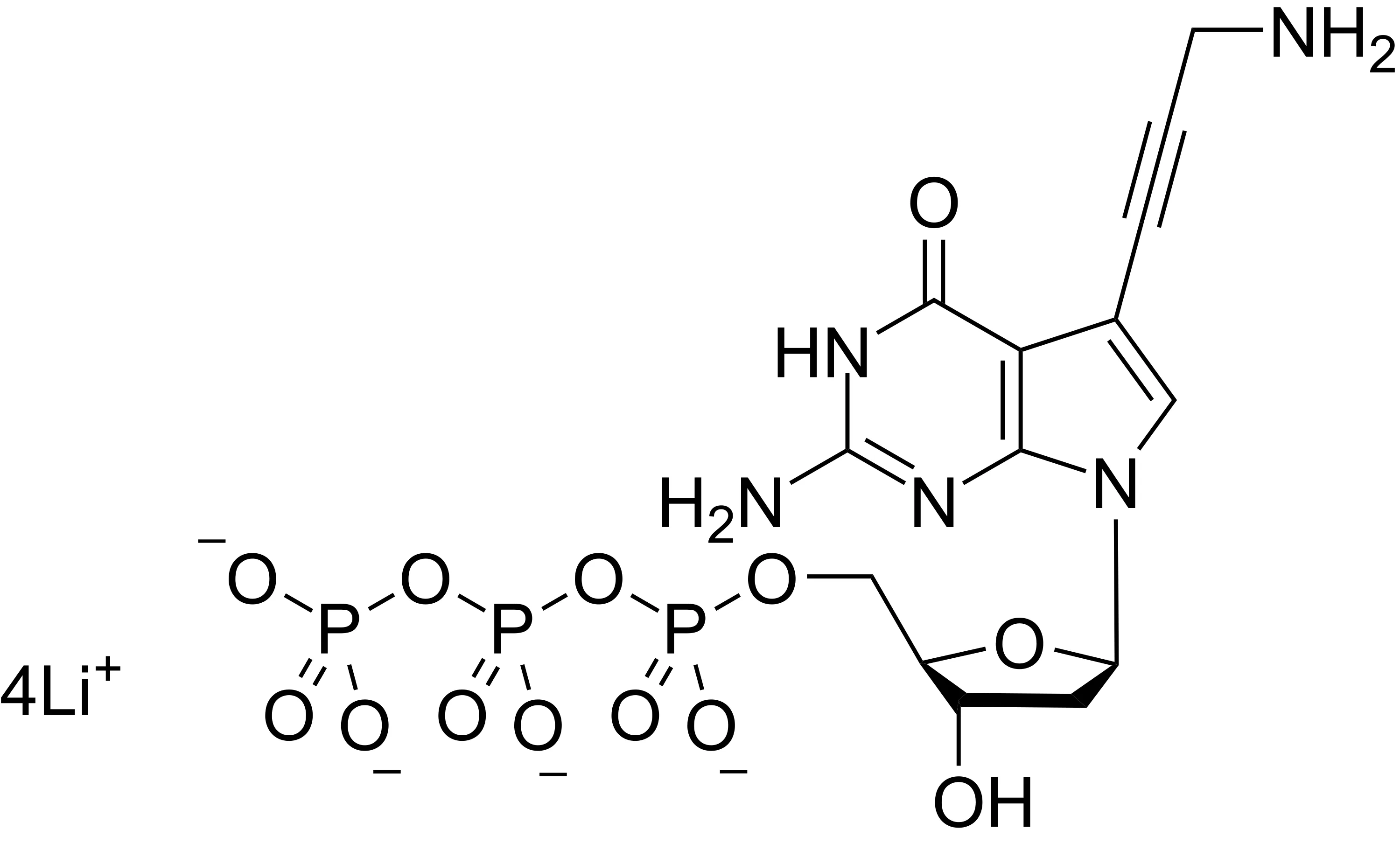
Aminopropargyl dGTP, also known as 5-propargylamino-2'-deoxyguanosine-5'-triphosphate, is an amine-modified deoxyguanosine nucleotide used in molecular biology and DNA labeling applications. Its modified structure allows the enzymatic incorporation of amino-containing nucleotide residues into DNA using suitable DNA synthesis and labeling methods.
This nucleotide can be used to produce amine-containing DNA through conventional enzymatic incorporation techniques, including reverse transcription, nick translation, random-primed labeling, and PCR. The resulting amino-modified DNA can be useful in downstream research workflows requiring functionalized nucleic acids.
Catalog Number: 0271-17059-AAT
Product Size: 10 µmole
Dry Ice Required: No
Hazardous Material: No
Product Specifications
| Product Name | Aminopropargyl dGTP |
| Full Chemical Name | 5-Propargylamino-2'-deoxyguanosine-5'-triphosphate |
| Catalog Number | 0271-17059-AAT |
| Size | 10 µmole |
| UNSPSC | 41116134 |
| H Phrases | H303, H313, H333 |
| R Phrases | R20, R21, R22 |
| Shipping Conditions | Blue Ice |
| Storage Conditions | Store frozen below -15 °C. Minimize exposure to light. |
| Shelf Life | 6 months |
| Dry Ice | No |
| Hazardous | No |
Applications of Aminopropargyl dGTP
Amino-Modified DNA Synthesis
Aminopropargyl dGTP can be enzymatically incorporated into DNA to introduce amino-containing modifications, depending on the enzyme and reaction conditions.
PCR and DNA Labeling
This modified nucleotide can be used in suitable PCR and DNA labeling workflows to generate amino-modified DNA for downstream molecular biology research.
Downstream Functionalization
Amino-containing DNA may be suitable for subsequent chemical coupling or labeling procedures. Compatibility depends on the selected chemistry and experimental conditions.
Storage and Handling
Store frozen below -15 °C and minimize light exposure. Follow the product documentation for handling, preparation, and storage recommendations. The stated shelf life is 6 months.
Recent Posts
-
Digital PCR
Molecular Biology Guide Digital PCR (dPCR): Principles, Workflow, and Applications Explore how dig …21st Oct 2026 -
DNA Sequencing: Methods, Technologies, and Applications
Molecular Biology Guide DNA Sequencing: Methods, Technologies, and Applications Discover the princ …21st Oct 2026 -
Aminopropargyl dGTP [5-Propargylamino-2'-deoxyguanosine-5'-triphosphate]
Aminopropargyl dGTP 5-Propargylamino-2'-deoxyguanosine-5'-triphosphate Product Overview Aminopr …20th Oct 2026