
Bacteriophages
MICROBIOLOGY • VIROLOGY • BIOTECHNOLOGY
Bacteriophages: Infection Mechanisms and Therapeutic Applications
Understanding the viruses that infect bacteria and their emerging role in antimicrobial research, biotechnology and modern medicine.
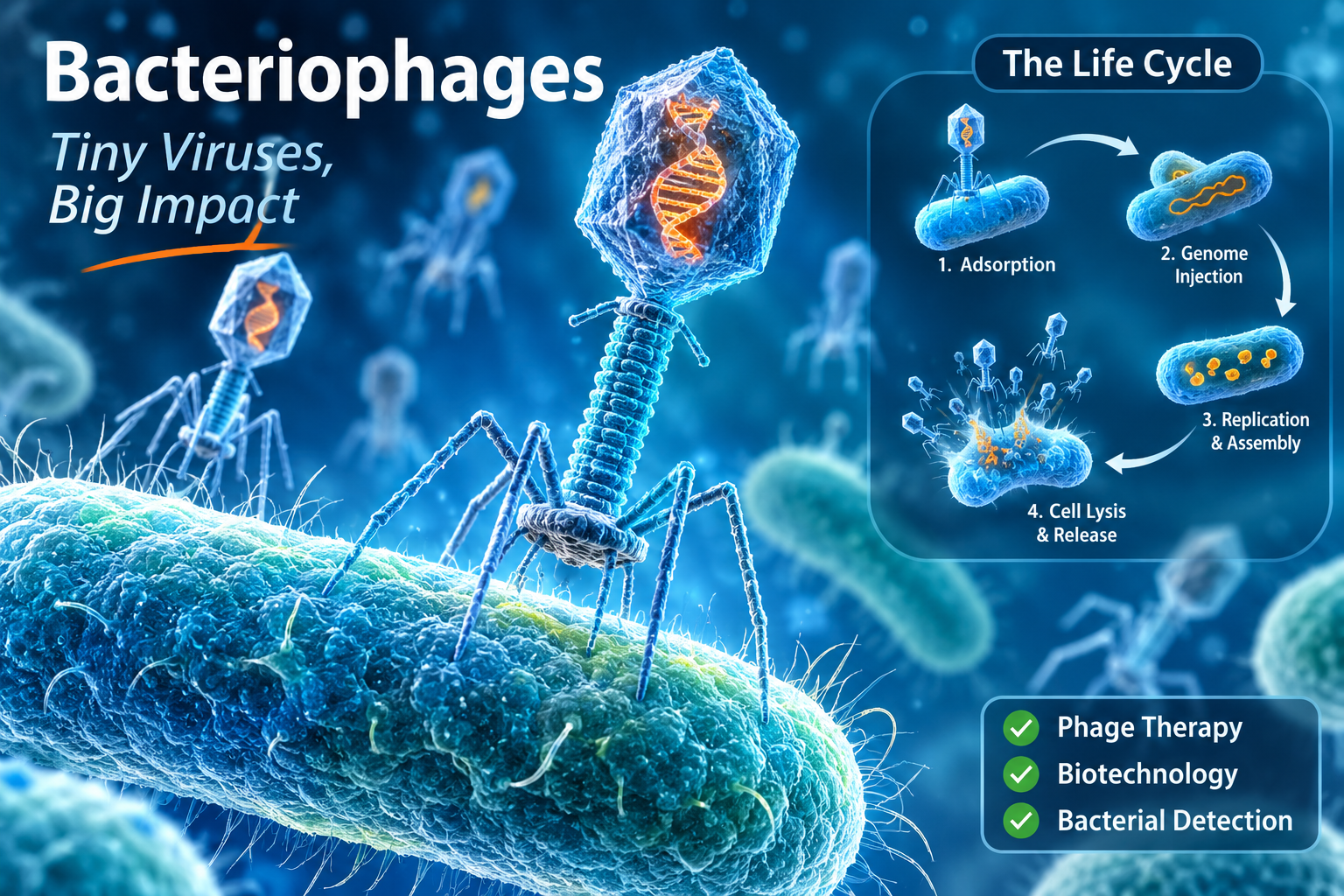
Bacteriophage structure, infection mechanisms and scientific applications.
1. Introduction to Bacteriophages
Bacteriophages, commonly known as phages, are viruses that specifically infect bacterial cells. They are among the most abundant biological entities on Earth and are found in diverse environments, including oceans, soil, wastewater, food systems and the human microbiome.
Unlike viruses that infect animal or plant cells, bacteriophages use bacterial cellular machinery to reproduce. Their interactions with bacterial populations influence microbial diversity, nutrient cycling, horizontal gene transfer and bacterial evolution.
Interest in bacteriophages has increased considerably because of their potential applications in combating antibiotic-resistant bacteria and developing targeted antimicrobial strategies.
Phages are highly diverse biological entities. Their host specificity and genetic diversity make them important subjects in microbiology, genomics and microbial ecology.
2. Structure and Components of Bacteriophages
Many well-characterized bacteriophages have a complex structure consisting of a protein capsid, genetic material and specialized structures involved in bacterial recognition and attachment.
Main Structural Components
- Capsid (head): A protein shell that protects the viral genome.
- Genetic material: DNA or RNA, depending on the phage species.
- Tail: In many phages, a structure involved in delivering genetic material into the bacterial cell.
- Tail fibers: Specialized proteins that recognize and bind to bacterial surface receptors.
- Baseplate: In many tailed phages, this structure participates in attachment and genome delivery.
Not all bacteriophages share the same morphology. Some have contractile tails, others have long non-contractile tails, while filamentous and other phages display distinct structural organizations.
3. Classification of Bacteriophages
Bacteriophages can be classified according to their genome composition, morphology, host range and replication strategy.
Lytic Bacteriophages
Lytic phages replicate inside susceptible bacterial cells and ultimately cause cell lysis, releasing newly formed viral particles.
They are particularly relevant to research on bacterial population control and phage-based antimicrobial applications.
Temperate Bacteriophages
Temperate phages can follow different developmental pathways. Their genetic material may integrate into the bacterial chromosome or persist in another stable form as a prophage.
Under particular conditions, prophages can become induced and enter a productive replication cycle.
Important distinction: Lytic and lysogenic lifestyles describe biological strategies rather than two completely separate morphological groups.
4. The Bacteriophage Life Cycle
The infection process involves several coordinated stages. Although the details vary between phages, a typical lytic infection includes the following steps:
The phage recognizes and attaches to specific receptors on the bacterial surface.
The viral genetic material enters the bacterial cell.
The phage redirects cellular resources to produce viral genomes and proteins.
New viral components are assembled into infectious particles.
Phage-encoded lysis mechanisms disrupt the bacterial cell envelope, releasing progeny phages.
In temperate phages, the infection may instead enter lysogeny, allowing the phage genome to persist within the bacterial host without immediately destroying the cell.
5. Phage–Bacteria Interactions and Bacterial Defense
Bacteriophages and bacteria participate in a continuous evolutionary arms race. Bacteria have developed several defense mechanisms that interfere with different stages of phage infection.
- Restriction-modification systems: Recognize and degrade foreign DNA.
- CRISPR-Cas immunity: Uses stored genetic sequences to recognize and target invading genetic material.
- Abortive infection: Can prevent phage propagation by disrupting the infected cell's ability to support viral replication.
- Receptor modification: Changes in bacterial surface structures can prevent phage attachment.
Phages also evolve countermeasures, including anti-CRISPR proteins and mechanisms that modify or protect their genetic material.
The study of bacteriophage interactions with bacterial defense systems has contributed significantly to understanding CRISPR-Cas immunity, a biological mechanism that has become central to genome-editing research.
6. Applications of Bacteriophages in Science and Biotechnology
6.1 Phage Therapy
Phage therapy uses selected bacteriophages to target bacterial pathogens. It has attracted renewed attention as antimicrobial resistance reduces the effectiveness of some conventional antibiotics.
Unlike broad-spectrum antibiotics, individual phages often have relatively narrow host ranges. This specificity can help target particular bacterial strains, although it also means that bacterial identification and phage susceptibility testing are important.
6.2 Bacterial Detection and Diagnostics
Phage-based diagnostic approaches exploit the ability of bacteriophages to recognize specific bacterial hosts. These approaches are being investigated for rapid pathogen identification, bacterial viability assessment and biosensor development.
6.3 Molecular Biology and Genetic Engineering
Phages have contributed to important developments in molecular biology, including DNA cloning, genome analysis, genetic recombination and the study of gene regulation.
Phage-derived enzymes and genetic elements are also valuable tools in biotechnology.
6.4 Food Safety and Biocontrol
Selected bacteriophages are investigated for their ability to reduce specific bacterial contaminants in food production and processing environments.
6.5 Microbiome Research
Phages influence bacterial abundance and community structure. Studying phage populations helps researchers understand microbial ecology, bacterial evolution and interactions within complex microbiomes.
7. Challenges and Limitations of Phage-Based Applications
Despite their potential, bacteriophages present several scientific and practical challenges.
- Host specificity: A phage may infect only a limited range of bacterial strains.
- Phage resistance: Bacteria can develop mechanisms that reduce susceptibility to infection.
- Immune interactions: The human immune system may recognize and clear administered phages.
- Manufacturing and quality control: Therapeutic preparations require careful characterization, purity assessment and consistency.
- Genetic safety: Phages must be carefully evaluated for undesirable genes, including those associated with virulence or antimicrobial resistance.
- Clinical evidence: Optimal treatment strategies, dosing and clinical effectiveness still require further investigation.
These limitations demonstrate why phage applications require careful biological characterization and rigorous scientific evaluation.
8. Future Perspectives in Bacteriophage Research
Modern phage research increasingly combines genomics, bioinformatics, structural biology and microbiology to improve the understanding and characterization of bacteriophages.
Emerging research directions include:
- Whole-genome sequencing and comparative phage genomics.
- Computational prediction of phage-host interactions.
- Development of phage cocktails with complementary host ranges.
- Investigation of phage-antibiotic combinations.
- Engineering of phages for targeted biological applications.
- Advanced investigation of phage interactions with bacterial biofilms.
These approaches may contribute to improved antimicrobial strategies and new biotechnology applications. However, their effectiveness and safety must be established through appropriate experimental and clinical research.
Conclusion
Bacteriophages are essential components of microbial ecosystems and powerful models for studying virus-host interactions. Their ability to infect specific bacteria makes them particularly interesting for antimicrobial research, molecular biology, diagnostics and biotechnology.
As genomic technologies and microbiological research continue to advance, bacteriophages are expected to remain important tools for understanding bacterial biology and exploring new approaches to infectious disease management.
9. Scientific References and Further Reading
The following peer-reviewed publications provide scientific foundations and further reading for this article.
Revisiting the life cycle of temperate phages.
Nature Reviews Microbiology.
Read the scientific article →Current status of bacteriophage therapy for severe bacterial infections.
Journal of Intensive Care, 12, 44.
Read the open-access article →Current status of clinical trials for phage therapy.
Journal of Medical Microbiology, 73(9).
Read the scientific article →Pharmacokinetics and pharmacodynamics of bacteriophage therapy: a review with a focus on multidrug-resistant Gram-negative bacterial infections.
Clinical Microbiology Reviews.
Read the scientific review →Coevolution between bacterial CRISPR-Cas systems and their bacteriophages.
Cell Host & Microbe.
Read the scientific article →A blueprint for broadly effective bacteriophage-antibiotic cocktails against bacterial infections.
Nature Communications, 15, 9987.
Read the research article →Explore More Scientific Research
Discover microbiology, molecular biology, virology and biotechnology research through scientific literature and laboratory resources.
Recent Posts
-
Bacteriophages
MICROBIOLOGY • VIROLOGY • BIOTECHNOLOGY Bacteriophages: Infection Mechanisms and Therapeutic Appl …9th Nov 2026 -
Ni-NTA Magnetic Agarose Beads
PROTEIN PURIFICATION | MOLECULAR BIOLOGY Ni-NTA Magnetic Agarose Beads: Principle, Protocol and Ap …6th Nov 2026 -
Human PTX3/Pentraxin 3 ELISA Kit PicoKine®
IMMUNOASSAYS & ELISA KITS Human PTX3/Pentraxin 3 ELISA Kit PicoKine® Sensitive quantitative measur …5th Nov 2026